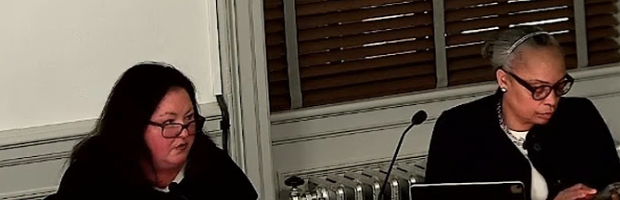
Part 1: How the City Council Is Handing the Mayor Control of $180 MillionOn February 9, 2026, the Mount Vernon City Council held what was advertised as a “regular work session.
”What it actually revealed is that—with one exception—the council is functioning as an extension of the Mayor’s Office, not an independent branch of government.While most members followed the script, Council member Andre Wallace did something rare in
Mount Vernon politics: he asked hard questions that went beyond the talking points.Everyone else? Henchmen and rubber stamps.
The Quiet Centralization of PowerThe most dangerous items on that tally sheet weren’t about snow shoveling or litter fines. They were the structural changes that quietly move control of money and decision-making out of shared boards and into the Mayor’s political orbit.Three moves stood out:
- Rewriting DPW’s leadership for “continuity.”
- Creating a “Chief of Infrastructure and Capital Improvements” inside the Mayor’s Office.
- Amending the City Charter to match the administration’s preferred staffing model.
Taken together, these moves strip power away from the checks and balances baked into the Charter and rebuild our government around one person and her inner circle.
1. The DPW “Reorg” That Isn’t About Service DeliveryFirst, the council entertained a proposal to eliminate a senior account clerk and a secretary in the Department of Public Works and merge them into a new Assistant Commissioner of DPW.On the surface, it sounds responsible: fewer people, more “continuity,” and some savings.Here’s what they glossed over:
- The Commissioner is leaving on February 20.
- This “assistant commissioner” is being sold as a stabilizer while he walks out the door.
- Civil Service has not finished classifying the position.
- The Mayor admitted the State has not yet decided whether this is a competitive (protected) title or an exempt/political one.
In plain English:The council is being asked to approve a newly created command-level position before there’s a clear ruling on whether it will be a regular civil service role or a political appointment dressed up as “continuity.”A genuinely independent council would have said:“Come back when Civil Service classification is finished. We’re not voting on hypothetical titles.” Instead, the majority listened politely, accepted the savings story, and moved on.
2. The Big Grab: Chief of Infrastructure in the Mayor’s OfficeThe most dangerous move of the night was Item 21 — reclassifying the DPW Deputy Commissioner (administrative) as Chief of Infrastructure and Capital Improvements and pulling that position into the Mayor’s Office.This is not a cosmetic title change. Here’s what it really does:- Puts oversight of roughly $180 million in capital projects under a person who serves at the pleasure of the Mayor.
- Extends that control across both DPW and the Water Department, even though those departments already have engineers and their own leadership.
- Uses grant funding (75% state, 25% Water Department) as political cover: “taxpayers aren’t really paying for this.”
The Mayor made no secret that this role is being built for a specific insider, currently serving as DPW’s deputy, who already has relationships with state agencies and has been doing much of this work informally. Was that the back-door dealing the Mayor performed while away at the Council of Mayors of New York Conference? If so, what did Mount Vernon get in return, or better yet, what did Shawyn Patterson-Howard receive in return? Council member Wallace was the only one to ask the obvious:
- How can someone be “Chief of Infrastructure” without an engineering background?
- Why do we need a new political-level chief when we already pay engineers and outside engineering firms?
- Why no open recruitment for a role this powerful?
The Mayor’s answer boiled down to: we need an administrator, we already have our person, and the state likes him.This is exactly how patronage and power consolidation work:- Write a job around a specific person.
- Park that job in the Mayor’s Office instead of in a neutral department.
- Pay for it with outside money so it sounds painless.
- Ask the council to bless it retroactively.
And the council—again with the exception of Wallace—dutifully played along.
3. Undermining the Capital Projects Board Without Saying Its NameThere’s a reason this “Chief of Infrastructure” move should scare every homeowner and taxpayer: it walks right past the Capital Projects Board that the City Charter already created to oversee capital spending.By design, that board was supposed to be a shared power structure:
- The Comptroller
- The City Engineer
- A Planning Board member
- Two City Council members (with one as chair)
Its job is to review and recommend capital projects before they hit the budget. It’s the Charter’s way of saying:“No one person should control the capital spigot.” Instead of demanding that this board finally be empowered and used as written, the administration is doing two things:
- Creating a centralized “Chief of Infrastructure” in the Mayor’s Office, who will effectively run point on those same projects.
- Pushing a local law to amend the Capital Projects Board section of the Charter, reshaping its composition to better match the administration’s preferences.
And the council? They are letting it happen.At no point did the majority say:
- “Why are we creating a new chief instead of using the board the Charter already gave us?”
- “Are we weakening our own seat at the table on capital projects by amending this section?”
- “Why is this board only suddenly important now that the Mayor wants to rewrite it?”
You can’t claim to respect the Charter while you’re actively sandblasting the parts that inconvenience the Mayor.
4. Codifying the Mayor’s Political Staff in the CharterAs if that weren’t enough, the council also entertained a local law to codify the Mayor’s Chief of Staff and Deputy Chief of Staff in the City Charter.Let’s be clear:- Those positions already exist.
- The Mayor is already using them.
- No one believes she lacks authority to hire staff.
So what does writing them into the Charter do?- It takes what should be ordinary staffing decisions and hard-wires them into the city’s foundational document.
- It elevates the Mayor’s personal staff to the same level as long-standing executive offices that were originally intended to be part of a balanced structure.
The Mayor argued that codification does not guarantee they are funded. That’s technically true. But she’s not asking for a budget item; she’s asking for something more enduring:She wants the idea of these staff positions locked into the Charter so every future administration starts from her staffing blueprint. And again, the council majority nodded along. There was more concern about whether other administrations “could go down to three or four staff” than about whether this is even appropriate material for the Charter.Here’s the real test:If you can read the Charter without seeing a stronger public voice, clearer checks, or more transparency—but you do see the Mayor’s staff and power concentrated—your council is serving one office, not the people.
5. The Lone Dissenting VoiceThroughout the meeting, Andre Wallace did what every council member should have done:- Questioned qualifications.
- Pushed back on vague language.
- Asked what happens to existing boards and processes.
- Tried to understand who really benefits from each move.
He wasn’t always given full, clear answers. More importantly, he was largely alone.That’s the story that should worry residents the most:Not just that the administration is aggressive about gathering power — but that the legislative body whose job is to say “no” or “not like this” rarely does either. What This All Means for YouIf you remember nothing else from Part 1, remember this:- Every time the council amends the Charter to match one administration’s convenience, the Charter gets weaker and the Mayor gets stronger.
- Every time the council approves new political-level positions without clear Civil Service rulings and open hiring, the spoils system grows.
- Every time the council lets a new “chief” replace an existing board, your checks and balances shrink.
You don’t have to be a lawyer to understand what’s happening. You just have to watch who asks hard questions and who folds.Right now, Mount Vernon has one councilmember behaving like an independent branch of government. |